AI prompts
base on A hyperparameter optimization framework <div align="center"><img src="https://raw.githubusercontent.com/optuna/optuna/master/docs/image/optuna-logo.png" width="800"/></div>
# Optuna: A hyperparameter optimization framework
[](https://www.python.org)
[](https://pypi.python.org/pypi/optuna)
[](https://anaconda.org/conda-forge/optuna)
[](https://github.com/optuna/optuna)
[](https://optuna.readthedocs.io/en/stable/)
:link: [**Website**](https://optuna.org/)
| :page_with_curl: [**Docs**](https://optuna.readthedocs.io/en/stable/)
| :gear: [**Install Guide**](https://optuna.readthedocs.io/en/stable/installation.html)
| :pencil: [**Tutorial**](https://optuna.readthedocs.io/en/stable/tutorial/index.html)
| :bulb: [**Examples**](https://github.com/optuna/optuna-examples)
| [**Twitter**](https://twitter.com/OptunaAutoML)
| [**LinkedIn**](https://www.linkedin.com/showcase/optuna/)
| [**Medium**](https://medium.com/optuna)
*Optuna* is an automatic hyperparameter optimization software framework, particularly designed
for machine learning. It features an imperative, *define-by-run* style user API. Thanks to our
*define-by-run* API, the code written with Optuna enjoys high modularity, and the user of
Optuna can dynamically construct the search spaces for the hyperparameters.
## :loudspeaker: News
Help us create the next version of Optuna!
Optuna 5.0 Roadmap published for review. Please take a look at [the planned improvements to Optuna](https://medium.com/optuna/optuna-v5-roadmap-ac7d6935a878), and share your feedback in [the github issues](https://github.com/optuna/optuna/labels/v5). PR contributions also welcome!
Please take a few minutes to fill in [this survey](https://forms.gle/wVwLCQ9g6st6AXuq9), and let us know how you use Optuna now and what improvements you'd like.🤔
All questions are optional. 🙇♂️
<!-- TODO: when you add a new line, please delete the oldest line -->
* **Nov 10, 2025**: A new article [Announcing Optuna 4.6](https://medium.com/optuna/announcing-optuna-4-6-a9e82183ab07) has been published.
* **Oct 28, 2025**: A new article [AutoSampler: Full Support for Multi-Objective & Constrained Optimization](https://medium.com/optuna/autosampler-full-support-for-multi-objective-constrained-optimization-c1c4fc957ba2) has been published.
* **Sep 22, 2025**: A new article [[Optuna v4.5] Gaussian Process-Based Sampler (GPSampler) Can Now Perform Constrained Multi-Objective Optimization](https://medium.com/optuna/optuna-v4-5-81e78d8e077a) has been published.
* **Jun 16, 2025**: Optuna 4.4.0 has been released! Check out [the release blog](https://medium.com/optuna/announcing-optuna-4-4-ece661493126).
* **May 26, 2025**: Optuna 5.0 roadmap has been published! See [the blog](https://medium.com/optuna/optuna-v5-roadmap-ac7d6935a878) for more details.
* **Apr 14, 2025**: Optuna 4.3.0 is out! Check out [the release note](https://github.com/optuna/optuna/releases/tag/v4.3.0) for details.
## :fire: Key Features
Optuna has modern functionalities as follows:
- [Lightweight, versatile, and platform agnostic architecture](https://optuna.readthedocs.io/en/stable/tutorial/10_key_features/001_first.html)
- Handle a wide variety of tasks with a simple installation that has few requirements.
- [Pythonic search spaces](https://optuna.readthedocs.io/en/stable/tutorial/10_key_features/002_configurations.html)
- Define search spaces using familiar Python syntax including conditionals and loops.
- [Efficient optimization algorithms](https://optuna.readthedocs.io/en/stable/tutorial/10_key_features/003_efficient_optimization_algorithms.html)
- Adopt state-of-the-art algorithms for sampling hyperparameters and efficiently pruning unpromising trials.
- [Easy parallelization](https://optuna.readthedocs.io/en/stable/tutorial/10_key_features/004_distributed.html)
- Scale studies to tens or hundreds of workers with little or no changes to the code.
- [Quick visualization](https://optuna.readthedocs.io/en/stable/tutorial/10_key_features/005_visualization.html)
- Inspect optimization histories from a variety of plotting functions.
## Basic Concepts
We use the terms *study* and *trial* as follows:
- Study: optimization based on an objective function
- Trial: a single execution of the objective function
Please refer to the sample code below. The goal of a *study* is to find out the optimal set of
hyperparameter values (e.g., `regressor` and `svr_c`) through multiple *trials* (e.g.,
`n_trials=100`). Optuna is a framework designed for automation and acceleration of
optimization *studies*.
<details open>
<summary>Sample code with scikit-learn</summary>
[](http://colab.research.google.com/github/optuna/optuna-examples/blob/main/quickstart.ipynb)
```python
import optuna
import sklearn
# Define an objective function to be minimized.
def objective(trial):
# Invoke suggest methods of a Trial object to generate hyperparameters.
regressor_name = trial.suggest_categorical("regressor", ["SVR", "RandomForest"])
if regressor_name == "SVR":
svr_c = trial.suggest_float("svr_c", 1e-10, 1e10, log=True)
regressor_obj = sklearn.svm.SVR(C=svr_c)
else:
rf_max_depth = trial.suggest_int("rf_max_depth", 2, 32)
regressor_obj = sklearn.ensemble.RandomForestRegressor(max_depth=rf_max_depth)
X, y = sklearn.datasets.fetch_california_housing(return_X_y=True)
X_train, X_val, y_train, y_val = sklearn.model_selection.train_test_split(X, y, random_state=0)
regressor_obj.fit(X_train, y_train)
y_pred = regressor_obj.predict(X_val)
error = sklearn.metrics.mean_squared_error(y_val, y_pred)
return error # An objective value linked with the Trial object.
study = optuna.create_study() # Create a new study.
study.optimize(objective, n_trials=100) # Invoke optimization of the objective function.
```
</details>
> [!NOTE]
> More examples can be found in [optuna/optuna-examples](https://github.com/optuna/optuna-examples).
>
> The examples cover diverse problem setups such as multi-objective optimization, constrained optimization, pruning, and distributed optimization.
## Installation
Optuna is available at [the Python Package Index](https://pypi.org/project/optuna/) and on [Anaconda Cloud](https://anaconda.org/conda-forge/optuna).
```bash
# PyPI
$ pip install optuna
```
```bash
# Anaconda Cloud
$ conda install -c conda-forge optuna
```
> [!IMPORTANT]
> Optuna supports Python 3.9 or newer.
>
> Also, we provide Optuna docker images on [DockerHub](https://hub.docker.com/r/optuna/optuna).
## Integrations
Optuna has integration features with various third-party libraries. Integrations can be found in [optuna/optuna-integration](https://github.com/optuna/optuna-integration) and the document is available [here](https://optuna-integration.readthedocs.io/en/stable/index.html).
<details>
<summary>Supported integration libraries</summary>
* [Catboost](https://github.com/optuna/optuna-examples/tree/main/catboost/catboost_pruning.py)
* [Dask](https://github.com/optuna/optuna-examples/tree/main/dask/dask_simple.py)
* [fastai](https://github.com/optuna/optuna-examples/tree/main/fastai/fastai_simple.py)
* [Keras](https://github.com/optuna/optuna-examples/tree/main/keras/keras_integration.py)
* [LightGBM](https://github.com/optuna/optuna-examples/tree/main/lightgbm/lightgbm_integration.py)
* [MLflow](https://github.com/optuna/optuna-examples/tree/main/mlflow/keras_mlflow.py)
* [PyTorch](https://github.com/optuna/optuna-examples/tree/main/pytorch/pytorch_simple.py)
* [PyTorch Ignite](https://github.com/optuna/optuna-examples/tree/main/pytorch/pytorch_ignite_simple.py)
* [PyTorch Lightning](https://github.com/optuna/optuna-examples/tree/main/pytorch/pytorch_lightning_simple.py)
* [TensorBoard](https://github.com/optuna/optuna-examples/tree/main/tensorboard/tensorboard_simple.py)
* [TensorFlow](https://github.com/optuna/optuna-examples/tree/main/tensorflow/tensorflow_estimator_integration.py)
* [tf.keras](https://github.com/optuna/optuna-examples/tree/main/tfkeras/tfkeras_integration.py)
* [Weights & Biases](https://github.com/optuna/optuna-examples/tree/main/wandb/wandb_integration.py)
* [XGBoost](https://github.com/optuna/optuna-examples/tree/main/xgboost/xgboost_integration.py)
</details>
## Web Dashboard
[Optuna Dashboard](https://github.com/optuna/optuna-dashboard) is a real-time web dashboard for Optuna.
You can check the optimization history, hyperparameter importance, etc. in graphs and tables.
You don't need to create a Python script to call [Optuna's visualization](https://optuna.readthedocs.io/en/stable/reference/visualization/index.html) functions.
Feature requests and bug reports are welcome!
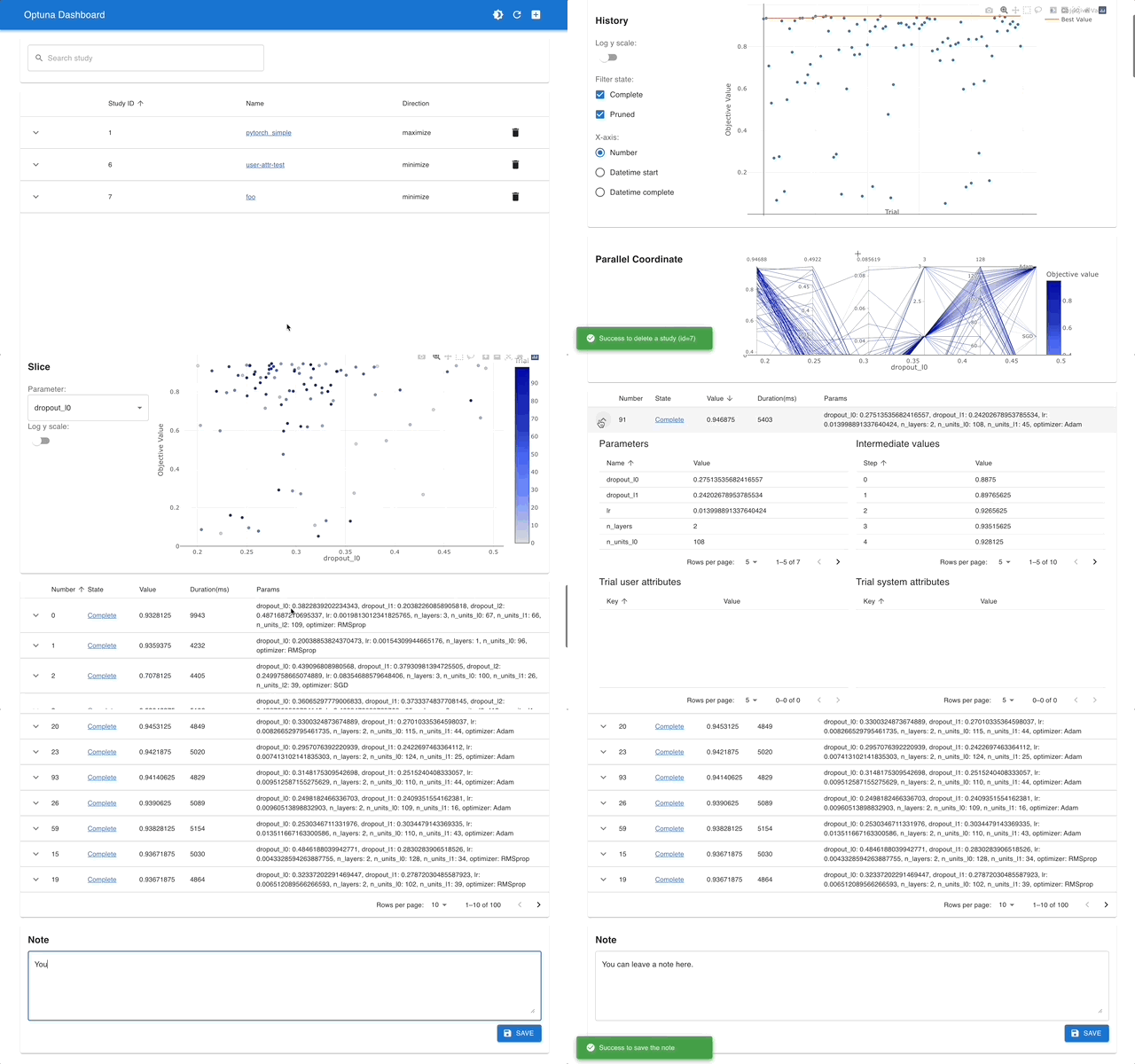
`optuna-dashboard` can be installed via pip:
```shell
$ pip install optuna-dashboard
```
> [!TIP]
> Please check out the convenience of Optuna Dashboard using the sample code below.
<details>
<summary>Sample code to launch Optuna Dashboard</summary>
Save the following code as `optimize_toy.py`.
```python
import optuna
def objective(trial):
x1 = trial.suggest_float("x1", -100, 100)
x2 = trial.suggest_float("x2", -100, 100)
return x1**2 + 0.01 * x2**2
study = optuna.create_study(storage="sqlite:///db.sqlite3") # Create a new study with database.
study.optimize(objective, n_trials=100)
```
Then try the commands below:
```shell
# Run the study specified above
$ python optimize_toy.py
# Launch the dashboard based on the storage `sqlite:///db.sqlite3`
$ optuna-dashboard sqlite:///db.sqlite3
...
Listening on http://localhost:8080/
Hit Ctrl-C to quit.
```
</details>
## OptunaHub
[OptunaHub](https://hub.optuna.org/) is a feature-sharing platform for Optuna.
You can use the registered features and publish your packages.
### Use registered features
`optunahub` can be installed via pip:
```shell
$ pip install optunahub
# Install AutoSampler dependencies (CPU only is sufficient for PyTorch)
$ pip install cmaes scipy torch --extra-index-url https://download.pytorch.org/whl/cpu
```
You can load registered module with `optunahub.load_module`.
```python
import optuna
import optunahub
def objective(trial: optuna.Trial) -> float:
x = trial.suggest_float("x", -5, 5)
y = trial.suggest_float("y", -5, 5)
return x**2 + y**2
module = optunahub.load_module(package="samplers/auto_sampler")
study = optuna.create_study(sampler=module.AutoSampler())
study.optimize(objective, n_trials=10)
print(study.best_trial.value, study.best_trial.params)
```
For more details, please refer to [the optunahub documentation](https://optuna.github.io/optunahub/).
### Publish your packages
You can publish your package via [optunahub-registry](https://github.com/optuna/optunahub-registry).
See the [Tutorials for Contributors](https://optuna.github.io/optunahub/tutorials_for_contributors.html) in OptunaHub.
## Communication
- [GitHub Discussions] for questions.
- [GitHub Issues] for bug reports and feature requests.
[GitHub Discussions]: https://github.com/optuna/optuna/discussions
[GitHub issues]: https://github.com/optuna/optuna/issues
## Contribution
Any contributions to Optuna are more than welcome!
If you are new to Optuna, please check the [good first issues](https://github.com/optuna/optuna/labels/good%20first%20issue). They are relatively simple, well-defined, and often good starting points for you to get familiar with the contribution workflow and other developers.
If you already have contributed to Optuna, we recommend the other [contribution-welcome issues](https://github.com/optuna/optuna/labels/contribution-welcome).
For general guidelines on how to contribute to the project, take a look at [CONTRIBUTING.md](./CONTRIBUTING.md).
## Reference
If you use Optuna in one of your research projects, please cite [our KDD paper](https://doi.org/10.1145/3292500.3330701) "Optuna: A Next-generation Hyperparameter Optimization Framework":
<details open>
<summary>BibTeX</summary>
```bibtex
@inproceedings{akiba2019optuna,
title={{O}ptuna: A Next-Generation Hyperparameter Optimization Framework},
author={Akiba, Takuya and Sano, Shotaro and Yanase, Toshihiko and Ohta, Takeru and Koyama, Masanori},
booktitle={The 25th ACM SIGKDD International Conference on Knowledge Discovery \& Data Mining},
pages={2623--2631},
year={2019}
}
```
</details>
## License
MIT License (see [LICENSE](./LICENSE)).
Optuna uses the codes from SciPy and fdlibm projects (see [LICENSE_THIRD_PARTY](./LICENSE_THIRD_PARTY)).
", Assign "at most 3 tags" to the expected json: {"id":"7721","tags":[]} "only from the tags list I provide: [{"id":77,"name":"3d"},{"id":89,"name":"agent"},{"id":17,"name":"ai"},{"id":54,"name":"algorithm"},{"id":24,"name":"api"},{"id":44,"name":"authentication"},{"id":3,"name":"aws"},{"id":27,"name":"backend"},{"id":60,"name":"benchmark"},{"id":72,"name":"best-practices"},{"id":39,"name":"bitcoin"},{"id":37,"name":"blockchain"},{"id":1,"name":"blog"},{"id":45,"name":"bundler"},{"id":58,"name":"cache"},{"id":21,"name":"chat"},{"id":49,"name":"cicd"},{"id":4,"name":"cli"},{"id":64,"name":"cloud-native"},{"id":48,"name":"cms"},{"id":61,"name":"compiler"},{"id":68,"name":"containerization"},{"id":92,"name":"crm"},{"id":34,"name":"data"},{"id":47,"name":"database"},{"id":8,"name":"declarative-gui "},{"id":9,"name":"deploy-tool"},{"id":53,"name":"desktop-app"},{"id":6,"name":"dev-exp-lib"},{"id":59,"name":"dev-tool"},{"id":13,"name":"ecommerce"},{"id":26,"name":"editor"},{"id":66,"name":"emulator"},{"id":62,"name":"filesystem"},{"id":80,"name":"finance"},{"id":15,"name":"firmware"},{"id":73,"name":"for-fun"},{"id":2,"name":"framework"},{"id":11,"name":"frontend"},{"id":22,"name":"game"},{"id":81,"name":"game-engine "},{"id":23,"name":"graphql"},{"id":84,"name":"gui"},{"id":91,"name":"http"},{"id":5,"name":"http-client"},{"id":51,"name":"iac"},{"id":30,"name":"ide"},{"id":78,"name":"iot"},{"id":40,"name":"json"},{"id":83,"name":"julian"},{"id":38,"name":"k8s"},{"id":31,"name":"language"},{"id":10,"name":"learning-resource"},{"id":33,"name":"lib"},{"id":41,"name":"linter"},{"id":28,"name":"lms"},{"id":16,"name":"logging"},{"id":76,"name":"low-code"},{"id":90,"name":"message-queue"},{"id":42,"name":"mobile-app"},{"id":18,"name":"monitoring"},{"id":36,"name":"networking"},{"id":7,"name":"node-version"},{"id":55,"name":"nosql"},{"id":57,"name":"observability"},{"id":46,"name":"orm"},{"id":52,"name":"os"},{"id":14,"name":"parser"},{"id":74,"name":"react"},{"id":82,"name":"real-time"},{"id":56,"name":"robot"},{"id":65,"name":"runtime"},{"id":32,"name":"sdk"},{"id":71,"name":"search"},{"id":63,"name":"secrets"},{"id":25,"name":"security"},{"id":85,"name":"server"},{"id":86,"name":"serverless"},{"id":70,"name":"storage"},{"id":75,"name":"system-design"},{"id":79,"name":"terminal"},{"id":29,"name":"testing"},{"id":12,"name":"ui"},{"id":50,"name":"ux"},{"id":88,"name":"video"},{"id":20,"name":"web-app"},{"id":35,"name":"web-server"},{"id":43,"name":"webassembly"},{"id":69,"name":"workflow"},{"id":87,"name":"yaml"}]" returns me the "expected json"