AI prompts
base on A rule based proxy in Go. <h1 align="center">
<img src="https://github.com/Dreamacro/clash/raw/master/docs/logo.png" alt="Clash" width="200">
<br>
Clash
<br>
</h1>
<h4 align="center">A rule based proxy in Go.</h4>
<p align="center">
<a href="https://travis-ci.org/Dreamacro/clash">
<img src="https://img.shields.io/travis/Dreamacro/clash.svg?style=flat-square"
alt="Travis-CI">
</a>
<a href="https://goreportcard.com/report/github.com/Dreamacro/clash">
<img src="https://goreportcard.com/badge/github.com/Dreamacro/clash?style=flat-square">
</a>
<a href="https://app.fossa.io/projects/git%2Bgithub.com%2FDreamacro%2Fclash?ref=badge_shield" alt="FOSSA Status"><img src="https://app.fossa.io/api/projects/git%2Bgithub.com%2FDreamacro%2Fclash.svg?type=shield"/></a>
<a href="https://github.com/Dreamacro/clash/releases">
<img src="https://img.shields.io/github/release/Dreamacro/clash/all.svg?style=flat-square">
</a>
</p>
## Features
- HTTP/HTTPS and SOCKS proxy
- Surge like configuration
- GeoIP rule support
## Install
You can build from source:
```sh
go get -u -v github.com/Dreamacro/clash
```
Pre-built binaries are available: [release](https://github.com/Dreamacro/clash/releases)
Requires Go >= 1.10.
## Daemon
Unfortunately, there is no native elegant way to implement golang's daemon.
So we can use third-party daemon tools like pm2, supervisor, and so on.
In the case of [pm2](https://github.com/Unitech/pm2), we can start the daemon this way:
```sh
pm2 start clash
```
If you have Docker installed, you can run clash directly using `docker-compose`.
[Run clash in docker](https://github.com/Dreamacro/clash/wiki/Run-clash-in-docker)
## Config
Configuration file at `$HOME/.config/clash/config.ini`
Below is a simple demo configuration file:
```ini
[General]
port = 7890
socks-port = 7891
# A RESTful API for clash
external-controller = 127.0.0.1:8080
[Proxy]
# name = ss, server, port, cipher, password
# The types of cipher are consistent with go-shadowsocks2
# support AEAD_AES_128_GCM AEAD_AES_192_GCM AEAD_AES_256_GCM AEAD_CHACHA20_POLY1305 AES-128-CTR AES-192-CTR AES-256-CTR AES-128-CFB AES-192-CFB AES-256-CFB CHACHA20-IETF XCHACHA20
Proxy1 = ss, server1, port, AEAD_CHACHA20_POLY1305, password
Proxy2 = ss, server2, port, AEAD_CHACHA20_POLY1305, password
[Proxy Group]
# url-test select which proxy will be used by benchmarking speed to a URL.
# name = url-test, [proxys], url, interval(second)
Proxy = url-test, Proxy1, Proxy2, http://www.google.com/generate_204, 300
[Rule]
DOMAIN-SUFFIX,google.com,Proxy
DOMAIN-KEYWORD,google,Proxy
DOMAIN-SUFFIX,ad.com,REJECT
GEOIP,CN,DIRECT
FINAL,,Proxy # note: there is two ","
```
## License
[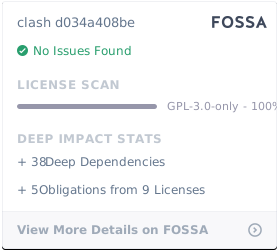](https://app.fossa.io/projects/git%2Bgithub.com%2FDreamacro%2Fclash?ref=badge_large)
## TODO
- [ ] Complementing the necessary rule operators
", Assign "at most 3 tags" to the expected json: {"id":"7946","tags":[]} "only from the tags list I provide: []" returns me the "expected json"