AI prompts
base on 🚦 A pretty diagnostics, references, telescope results, quickfix and location list to help you solve all the trouble your code is causing. # 🚦 Trouble
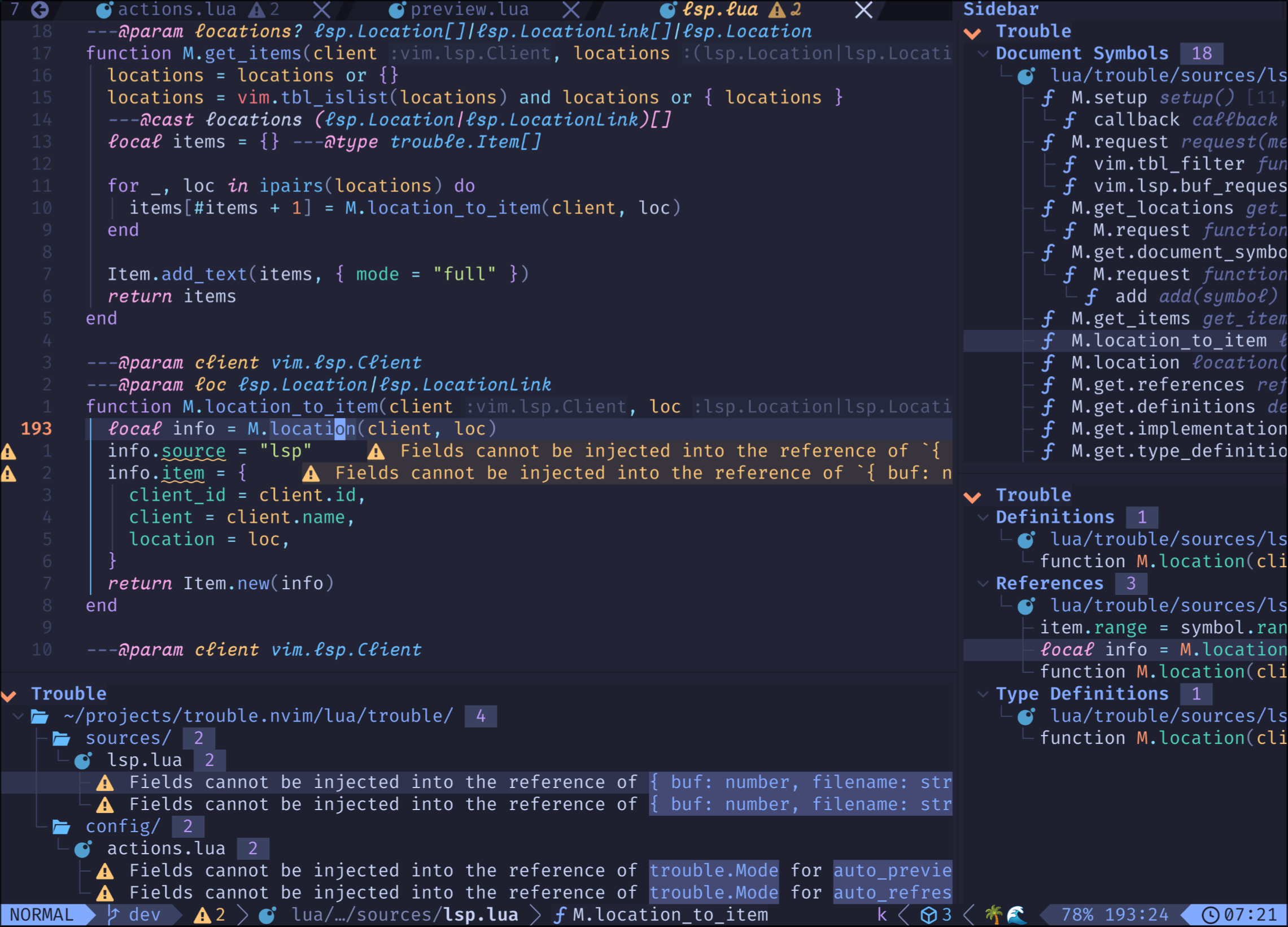
A pretty list for showing diagnostics, references, telescope results, quickfix and location lists to help you solve all the trouble your code is causing.
## ✨ Features
- Diagnostics
- LSP references
- LSP implementations
- LSP definitions
- LSP type definitions
- LSP Document Symbols
- LSP Incoming/Outgoing calls
- quickfix list
- location list
- [Telescope](https://github.com/nvim-telescope/telescope.nvim) search results
- [fzf-lua](https://github.com/ibhagwan/fzf-lua) results
## 📰 What's new?
This is a full rewrite of the original **trouble.nvim**.
The new version is much more flexible and powerful,
with a lot of new features and improvements:
- multiple trouble windows at the same time
- LSP document symbols
- LSP incoming/outgoing calls
- lots of options to configure trouble windows (floats or splits)
- `focus` option to focus the trouble window when opened (or not)
- `follow` option to follow the item under the cursor
- `pinned` option to pin the buffer as the source for the opened trouble window
- full tree views of anything
- highly configurable views with custom formatters, filters, and sorters
- show multiple sections in the same view
- multi-line messages
- prettier and configurable indent guides
- tree view that follows the natural hierarchy of the items (like document symbols, or file structure)
- expansive API and `Trouble` command
- trouble `modes` to define custom views
- statusline component (useful with document symbols)
## ⚡️ Requirements
- Neovim >= 0.9.2
- Neovim >= 0.10.0 **OR** the `markdown` and `markdown_inline` [nvim-treesitter](https://github.com/nvim-treesitter/nvim-treesitter) parsers
- Properly configured Neovim LSP client
- [nvim-web-devicons](https://github.com/nvim-tree/nvim-web-devicons) is optional to enable file icons
- a theme with properly configured highlight groups for Neovim Diagnostics
- a [patched font](https://www.nerdfonts.com/) for the default severity and fold icons
## 📦 Installation
Install the plugin with your preferred package manager:
### [lazy.nvim](https://github.com/folke/lazy.nvim)
```lua
{
"folke/trouble.nvim",
opts = {}, -- for default options, refer to the configuration section for custom setup.
cmd = "Trouble",
keys = {
{
"<leader>xx",
"<cmd>Trouble diagnostics toggle<cr>",
desc = "Diagnostics (Trouble)",
},
{
"<leader>xX",
"<cmd>Trouble diagnostics toggle filter.buf=0<cr>",
desc = "Buffer Diagnostics (Trouble)",
},
{
"<leader>cs",
"<cmd>Trouble symbols toggle focus=false<cr>",
desc = "Symbols (Trouble)",
},
{
"<leader>cl",
"<cmd>Trouble lsp toggle focus=false win.position=right<cr>",
desc = "LSP Definitions / references / ... (Trouble)",
},
{
"<leader>xL",
"<cmd>Trouble loclist toggle<cr>",
desc = "Location List (Trouble)",
},
{
"<leader>xQ",
"<cmd>Trouble qflist toggle<cr>",
desc = "Quickfix List (Trouble)",
},
},
}
```
## ⚙️ Configuration
### Setup
**Trouble** is highly configurable. Please refer to the default settings below.
<details><summary>Default Settings</summary>
<!-- config:start -->
```lua
---@class trouble.Mode: trouble.Config,trouble.Section.spec
---@field desc? string
---@field sections? string[]
---@class trouble.Config
---@field mode? string
---@field config? fun(opts:trouble.Config)
---@field formatters? table<string,trouble.Formatter> custom formatters
---@field filters? table<string, trouble.FilterFn> custom filters
---@field sorters? table<string, trouble.SorterFn> custom sorters
local defaults = {
auto_close = false, -- auto close when there are no items
auto_open = false, -- auto open when there are items
auto_preview = true, -- automatically open preview when on an item
auto_refresh = true, -- auto refresh when open
auto_jump = false, -- auto jump to the item when there's only one
focus = false, -- Focus the window when opened
restore = true, -- restores the last location in the list when opening
follow = true, -- Follow the current item
indent_guides = true, -- show indent guides
max_items = 200, -- limit number of items that can be displayed per section
multiline = true, -- render multi-line messages
pinned = false, -- When pinned, the opened trouble window will be bound to the current buffer
warn_no_results = true, -- show a warning when there are no results
open_no_results = false, -- open the trouble window when there are no results
---@type trouble.Window.opts
win = {}, -- window options for the results window. Can be a split or a floating window.
-- Window options for the preview window. Can be a split, floating window,
-- or `main` to show the preview in the main editor window.
---@type trouble.Window.opts
preview = {
type = "main",
-- when a buffer is not yet loaded, the preview window will be created
-- in a scratch buffer with only syntax highlighting enabled.
-- Set to false, if you want the preview to always be a real loaded buffer.
scratch = true,
},
-- Throttle/Debounce settings. Should usually not be changed.
---@type table<string, number|{ms:number, debounce?:boolean}>
throttle = {
refresh = 20, -- fetches new data when needed
update = 10, -- updates the window
render = 10, -- renders the window
follow = 100, -- follows the current item
preview = { ms = 100, debounce = true }, -- shows the preview for the current item
},
-- Key mappings can be set to the name of a builtin action,
-- or you can define your own custom action.
---@type table<string, trouble.Action.spec|false>
keys = {
["?"] = "help",
r = "refresh",
R = "toggle_refresh",
q = "close",
o = "jump_close",
["<esc>"] = "cancel",
["<cr>"] = "jump",
["<2-leftmouse>"] = "jump",
["<c-s>"] = "jump_split",
["<c-v>"] = "jump_vsplit",
-- go down to next item (accepts count)
-- j = "next",
["}"] = "next",
["]]"] = "next",
-- go up to prev item (accepts count)
-- k = "prev",
["{"] = "prev",
["[["] = "prev",
dd = "delete",
d = { action = "delete", mode = "v" },
i = "inspect",
p = "preview",
P = "toggle_preview",
zo = "fold_open",
zO = "fold_open_recursive",
zc = "fold_close",
zC = "fold_close_recursive",
za = "fold_toggle",
zA = "fold_toggle_recursive",
zm = "fold_more",
zM = "fold_close_all",
zr = "fold_reduce",
zR = "fold_open_all",
zx = "fold_update",
zX = "fold_update_all",
zn = "fold_disable",
zN = "fold_enable",
zi = "fold_toggle_enable",
gb = { -- example of a custom action that toggles the active view filter
action = function(view)
view:filter({ buf = 0 }, { toggle = true })
end,
desc = "Toggle Current Buffer Filter",
},
s = { -- example of a custom action that toggles the severity
action = function(view)
local f = view:get_filter("severity")
local severity = ((f and f.filter.severity or 0) + 1) % 5
view:filter({ severity = severity }, {
id = "severity",
template = "{hl:Title}Filter:{hl} {severity}",
del = severity == 0,
})
end,
desc = "Toggle Severity Filter",
},
},
---@type table<string, trouble.Mode>
modes = {
-- sources define their own modes, which you can use directly,
-- or override like in the example below
lsp_references = {
-- some modes are configurable, see the source code for more details
params = {
include_declaration = true,
},
},
-- The LSP base mode for:
-- * lsp_definitions, lsp_references, lsp_implementations
-- * lsp_type_definitions, lsp_declarations, lsp_command
lsp_base = {
params = {
-- don't include the current location in the results
include_current = false,
},
},
-- more advanced example that extends the lsp_document_symbols
symbols = {
desc = "document symbols",
mode = "lsp_document_symbols",
focus = false,
win = { position = "right" },
filter = {
-- remove Package since luals uses it for control flow structures
["not"] = { ft = "lua", kind = "Package" },
any = {
-- all symbol kinds for help / markdown files
ft = { "help", "markdown" },
-- default set of symbol kinds
kind = {
"Class",
"Constructor",
"Enum",
"Field",
"Function",
"Interface",
"Method",
"Module",
"Namespace",
"Package",
"Property",
"Struct",
"Trait",
},
},
},
},
},
icons = {
---@type trouble.Indent.symbols
indent = {
top = "│ ",
middle = "├╴",
last = "└╴",
-- last = "-╴",
-- last = "╰╴", -- rounded
fold_open = " ",
fold_closed = " ",
ws = " ",
},
folder_closed = " ",
folder_open = " ",
kinds = {
Array = " ",
Boolean = " ",
Class = " ",
Constant = " ",
Constructor = " ",
Enum = " ",
EnumMember = " ",
Event = " ",
Field = " ",
File = " ",
Function = " ",
Interface = " ",
Key = " ",
Method = " ",
Module = " ",
Namespace = " ",
Null = " ",
Number = " ",
Object = " ",
Operator = " ",
Package = " ",
Property = " ",
String = " ",
Struct = " ",
TypeParameter = " ",
Variable = " ",
},
},
}
```
<!-- config:end -->
</details>
Make sure to check the [Examples](/docs/examples.md)!
## 🚀 Usage
### Commands
The **Trouble** command is a wrapper around the **Trouble** API.
It can do anything the regular API can do.
- `Trouble [mode] [action] [options]`
Some examples:
- Toggle diagnostics for the current buffer and stay in the current window:
- `Trouble diagnostics toggle focus=false filter.buf=0`
- Show document symbols on the right of the current window.
Keep the document symbols in sync with the buffer you started the command in.
- `Trouble symbols toggle pinned=true win.relative=win win.position=right`
- You can use **lua** code in the options for the `Trouble` command.
The examples below all do the same thing.
- `Trouble diagnostics filter.severity=vim.diagnostic.severity.ERROR`
- `Trouble diagnostics filter.severity = vim.diagnostic.severity.ERROR`
- `Trouble diagnostics filter = { severity=vim.diagnostic.severity.ERROR }`
- Merging of nested options, with or without quoting strings:
- `Trouble diagnostics win.type = split win.position=right`
- `Trouble diagnostics win = { type = split, position=right}`
- `Trouble diagnostics win = { type = "split", position='right'}`
Please refer to the API section for more information on the available actions and options.
Modes:
<!-- modes:start -->
- **diagnostics**: diagnostics
- **fzf**: FzfLua results previously opened with `require('trouble.sources.fzf').open()`.
- **fzf_files**: FzfLua results previously opened with `require('trouble.sources.fzf').open()`.
- **loclist**: Location List
- **lsp**: LSP definitions, references, implementations, type definitions, and declarations
- **lsp_command**: command
- **lsp_declarations**: declarations
- **lsp_definitions**: definitions
- **lsp_document_symbols**: document symbols
- **lsp_implementations**: implementations
- **lsp_incoming_calls**: Incoming Calls
- **lsp_outgoing_calls**: Outgoing Calls
- **lsp_references**: references
- **lsp_type_definitions**: type definitions
- **qflist**: Quickfix List
- **quickfix**: Quickfix List
- **snacks**: Snacks results previously opened with `require('trouble.sources.snacks').open()`.
- **snacks_files**: Snacks results previously opened with `require('trouble.sources.snacks').open()`.
- **symbols**: document symbols
- **telescope**: Telescope results previously opened with `require('trouble.sources.telescope').open()`.
- **telescope_files**: Telescope results previously opened with `require('trouble.sources.telescope').open()`.
<!-- modes:end -->
### Filters
Please refer to the [filter docs](docs/filter.md) for more information examples on filters.
### API
You can use the following functions in your keybindings:
<details><summary>API</summary>
<!-- api:start -->
```lua
-- Opens trouble with the given mode.
-- If a view is already open with the same mode,
-- it will be focused unless `opts.focus = false`.
-- When a view is already open and `opts.new = true`,
-- a new view will be created.
---@param opts? trouble.Mode | { new?: boolean, refresh?: boolean } | string
---@return trouble.View?
require("trouble").open(opts)
-- Closes the last open view matching the filter.
---@param opts? trouble.Mode|string
---@return trouble.View?
require("trouble").close(opts)
-- Toggle the view with the given mode.
---@param opts? trouble.Mode|string
---@return trouble.View?
require("trouble").toggle(opts)
-- Returns true if there is an open view matching the mode.
---@param opts? trouble.Mode|string
require("trouble").is_open(opts)
-- Refresh all open views. Normally this is done automatically,
-- unless you disabled auto refresh.
---@param opts? trouble.Mode|string
require("trouble").refresh(opts)
-- Get all items from the active view for a given mode.
---@param opts? trouble.Mode|string
require("trouble").get_items(opts)
-- Renders a trouble list as a statusline component.
-- Check the docs for examples.
---@param opts? trouble.Mode|string|{hl_group?:string}
---@return {get: (fun():string), has: (fun():boolean)}
require("trouble").statusline(opts)
-- Closes the preview and goes to the main window.
-- The Trouble window is not closed.
---@param opts? trouble.Mode | { new? : boolean } | string
---@return trouble.View
require("trouble").cancel(opts)
-- Open the preview
---@param opts? trouble.Mode | { new? : boolean } | string
---@return trouble.View
require("trouble").delete(opts)
-- filter
---@param opts? trouble.Mode | { new? : boolean } | string
---@return trouble.View
require("trouble").filter(opts)
-- Go to the first item
---@param opts? trouble.Mode | { new? : boolean } | string
---@return trouble.View
require("trouble").first(opts)
-- Focus the trouble window
---@param opts? trouble.Mode | { new? : boolean } | string
---@return trouble.View
require("trouble").focus(opts)
-- Fold close
---@param opts? trouble.Mode | { new? : boolean } | string
---@return trouble.View
require("trouble").fold_close(opts)
-- fold close all
---@param opts? trouble.Mode | { new? : boolean } | string
---@return trouble.View
require("trouble").fold_close_all(opts)
-- Fold close recursive
---@param opts? trouble.Mode | { new? : boolean } | string
---@return trouble.View
require("trouble").fold_close_recursive(opts)
-- fold disable
---@param opts? trouble.Mode | { new? : boolean } | string
---@return trouble.View
require("trouble").fold_disable(opts)
-- fold enable
---@param opts? trouble.Mode | { new? : boolean } | string
---@return trouble.View
require("trouble").fold_enable(opts)
-- fold more
---@param opts? trouble.Mode | { new? : boolean } | string
---@return trouble.View
require("trouble").fold_more(opts)
-- Fold open
---@param opts? trouble.Mode | { new? : boolean } | string
---@return trouble.View
require("trouble").fold_open(opts)
-- fold open all
---@param opts? trouble.Mode | { new? : boolean } | string
---@return trouble.View
require("trouble").fold_open_all(opts)
-- Fold open recursive
---@param opts? trouble.Mode | { new? : boolean } | string
---@return trouble.View
require("trouble").fold_open_recursive(opts)
-- fold reduce
---@param opts? trouble.Mode | { new? : boolean } | string
---@return trouble.View
require("trouble").fold_reduce(opts)
-- Fold toggle
---@param opts? trouble.Mode | { new? : boolean } | string
---@return trouble.View
require("trouble").fold_toggle(opts)
-- fold toggle enable
---@param opts? trouble.Mode | { new? : boolean } | string
---@return trouble.View
require("trouble").fold_toggle_enable(opts)
-- Fold toggle recursive
---@param opts? trouble.Mode | { new? : boolean } | string
---@return trouble.View
require("trouble").fold_toggle_recursive(opts)
-- fold update
---@param opts? trouble.Mode | { new? : boolean } | string
---@return trouble.View
require("trouble").fold_update(opts)
-- fold update all
---@param opts? trouble.Mode | { new? : boolean } | string
---@return trouble.View
require("trouble").fold_update_all(opts)
-- Show the help
---@param opts? trouble.Mode | { new? : boolean } | string
---@return trouble.View
require("trouble").help(opts)
-- Dump the item to the console
---@param opts? trouble.Mode | { new? : boolean } | string
---@return trouble.View
require("trouble").inspect(opts)
-- Jump to the item if on an item, otherwise fold the node
---@param opts? trouble.Mode | { new? : boolean } | string
---@return trouble.View
require("trouble").jump(opts)
-- Jump to the item and close the trouble window
---@param opts? trouble.Mode | { new? : boolean } | string
---@return trouble.View
require("trouble").jump_close(opts)
-- Jump to the item if on an item, otherwise do nothing
---@param opts? trouble.Mode | { new? : boolean } | string
---@return trouble.View
require("trouble").jump_only(opts)
-- Open the item in a split
---@param opts? trouble.Mode | { new? : boolean } | string
---@return trouble.View
require("trouble").jump_split(opts)
-- Open the item in a split and close the trouble window
---@param opts? trouble.Mode | { new? : boolean } | string
---@return trouble.View
require("trouble").jump_split_close(opts)
-- Open the item in a vsplit
---@param opts? trouble.Mode | { new? : boolean } | string
---@return trouble.View
require("trouble").jump_vsplit(opts)
-- Open the item in a vsplit and close the trouble window
---@param opts? trouble.Mode | { new? : boolean } | string
---@return trouble.View
require("trouble").jump_vsplit_close(opts)
-- Go to the last item
---@param opts? trouble.Mode | { new? : boolean } | string
---@return trouble.View
require("trouble").last(opts)
-- Go to the next item
---@param opts? trouble.Mode | { new? : boolean } | string
---@return trouble.View
require("trouble").next(opts)
-- Go to the previous item
---@param opts? trouble.Mode | { new? : boolean } | string
---@return trouble.View
require("trouble").prev(opts)
-- Open the preview
---@param opts? trouble.Mode | { new? : boolean } | string
---@return trouble.View
require("trouble").preview(opts)
-- Refresh the trouble source
---@param opts? trouble.Mode | { new? : boolean } | string
---@return trouble.View
require("trouble").refresh(opts)
-- Toggle the preview
---@param opts? trouble.Mode | { new? : boolean } | string
---@return trouble.View
require("trouble").toggle_preview(opts)
-- Toggle the auto refresh
---@param opts? trouble.Mode | { new? : boolean } | string
---@return trouble.View
require("trouble").toggle_refresh(opts)
```
<!-- api:end -->
</details>
### Telescope
You can easily open any search results in **Trouble**, by defining a custom action:
```lua
local actions = require("telescope.actions")
local open_with_trouble = require("trouble.sources.telescope").open
-- Use this to add more results without clearing the trouble list
local add_to_trouble = require("trouble.sources.telescope").add
local telescope = require("telescope")
telescope.setup({
defaults = {
mappings = {
i = { ["<c-t>"] = open_with_trouble },
n = { ["<c-t>"] = open_with_trouble },
},
},
})
```
When you open telescope, you can now hit `<c-t>` to open the results in **Trouble**
### fzf-lua
You can easily open any search results in **Trouble**, by defining a custom action:
```lua
local config = require("fzf-lua.config")
local actions = require("trouble.sources.fzf").actions
config.defaults.actions.files["ctrl-t"] = actions.open
```
When you open fzf-lua, you can now hit `<c-t>` to open the results in **Trouble**
### Statusline Component
Example for [lualine.nvim](https://github.com/nvim-lualine/lualine.nvim):
```lua
{
"nvim-lualine/lualine.nvim",
opts = function(_, opts)
local trouble = require("trouble")
local symbols = trouble.statusline({
mode = "lsp_document_symbols",
groups = {},
title = false,
filter = { range = true },
format = "{kind_icon}{symbol.name:Normal}",
-- The following line is needed to fix the background color
-- Set it to the lualine section you want to use
hl_group = "lualine_c_normal",
})
table.insert(opts.sections.lualine_c, {
symbols.get,
cond = symbols.has,
})
end,
}
```
## 🎨 Colors
The table below shows all the highlight groups defined for Trouble.
<details><summary>Highlight Groups</summary>
<!-- colors:start -->
| Highlight Group | Default Group | Description |
| --- | --- | --- |
| **TroubleBasename** | ***TroubleFilename*** | |
| **TroubleCode** | ***Special*** | |
| **TroubleCount** | ***TabLineSel*** | |
| **TroubleDirectory** | ***Directory*** | |
| **TroubleFilename** | ***Directory*** | |
| **TroubleIconArray** | ***@punctuation.bracket*** | |
| **TroubleIconBoolean** | ***@boolean*** | |
| **TroubleIconClass** | ***@type*** | |
| **TroubleIconConstant** | ***@constant*** | |
| **TroubleIconConstructor** | ***@constructor*** | |
| **TroubleIconDirectory** | ***Special*** | |
| **TroubleIconEnum** | ***@lsp.type.enum*** | |
| **TroubleIconEnumMember** | ***@lsp.type.enumMember*** | |
| **TroubleIconEvent** | ***Special*** | |
| **TroubleIconField** | ***@variable.member*** | |
| **TroubleIconFile** | ***Normal*** | |
| **TroubleIconFunction** | ***@function*** | |
| **TroubleIconInterface** | ***@lsp.type.interface*** | |
| **TroubleIconKey** | ***@lsp.type.keyword*** | |
| **TroubleIconMethod** | ***@function.method*** | |
| **TroubleIconModule** | ***@module*** | |
| **TroubleIconNamespace** | ***@module*** | |
| **TroubleIconNull** | ***@constant.builtin*** | |
| **TroubleIconNumber** | ***@number*** | |
| **TroubleIconObject** | ***@constant*** | |
| **TroubleIconOperator** | ***@operator*** | |
| **TroubleIconPackage** | ***@module*** | |
| **TroubleIconProperty** | ***@property*** | |
| **TroubleIconString** | ***@string*** | |
| **TroubleIconStruct** | ***@lsp.type.struct*** | |
| **TroubleIconTypeParameter** | ***@lsp.type.typeParameter*** | |
| **TroubleIconVariable** | ***@variable*** | |
| **TroubleIndent** | ***LineNr*** | |
| **TroubleIndentFoldClosed** | ***CursorLineNr*** | |
| **TroubleIndentFoldOpen** | ***TroubleIndent*** | |
| **TroubleIndentLast** | ***TroubleIndent*** | |
| **TroubleIndentMiddle** | ***TroubleIndent*** | |
| **TroubleIndentTop** | ***TroubleIndent*** | |
| **TroubleIndentWs** | ***TroubleIndent*** | |
| **TroubleNormal** | ***NormalFloat*** | |
| **TroubleNormalNC** | ***NormalFloat*** | |
| **TroublePos** | ***LineNr*** | |
| **TroublePreview** | ***Visual*** | |
| **TroubleSource** | ***Comment*** | |
| **TroubleText** | ***Normal*** | |
<!-- colors:end -->
</details>
", Assign "at most 3 tags" to the expected json: {"id":"8967","tags":[]} "only from the tags list I provide: [{"id":77,"name":"3d"},{"id":89,"name":"agent"},{"id":17,"name":"ai"},{"id":54,"name":"algorithm"},{"id":24,"name":"api"},{"id":44,"name":"authentication"},{"id":3,"name":"aws"},{"id":27,"name":"backend"},{"id":60,"name":"benchmark"},{"id":72,"name":"best-practices"},{"id":39,"name":"bitcoin"},{"id":37,"name":"blockchain"},{"id":1,"name":"blog"},{"id":45,"name":"bundler"},{"id":58,"name":"cache"},{"id":21,"name":"chat"},{"id":49,"name":"cicd"},{"id":4,"name":"cli"},{"id":64,"name":"cloud-native"},{"id":48,"name":"cms"},{"id":61,"name":"compiler"},{"id":68,"name":"containerization"},{"id":92,"name":"crm"},{"id":34,"name":"data"},{"id":47,"name":"database"},{"id":8,"name":"declarative-gui "},{"id":9,"name":"deploy-tool"},{"id":53,"name":"desktop-app"},{"id":6,"name":"dev-exp-lib"},{"id":59,"name":"dev-tool"},{"id":13,"name":"ecommerce"},{"id":26,"name":"editor"},{"id":66,"name":"emulator"},{"id":62,"name":"filesystem"},{"id":80,"name":"finance"},{"id":15,"name":"firmware"},{"id":73,"name":"for-fun"},{"id":2,"name":"framework"},{"id":11,"name":"frontend"},{"id":22,"name":"game"},{"id":81,"name":"game-engine "},{"id":23,"name":"graphql"},{"id":84,"name":"gui"},{"id":91,"name":"http"},{"id":5,"name":"http-client"},{"id":51,"name":"iac"},{"id":30,"name":"ide"},{"id":78,"name":"iot"},{"id":40,"name":"json"},{"id":83,"name":"julian"},{"id":38,"name":"k8s"},{"id":31,"name":"language"},{"id":10,"name":"learning-resource"},{"id":33,"name":"lib"},{"id":41,"name":"linter"},{"id":28,"name":"lms"},{"id":16,"name":"logging"},{"id":76,"name":"low-code"},{"id":90,"name":"message-queue"},{"id":42,"name":"mobile-app"},{"id":18,"name":"monitoring"},{"id":36,"name":"networking"},{"id":7,"name":"node-version"},{"id":55,"name":"nosql"},{"id":57,"name":"observability"},{"id":46,"name":"orm"},{"id":52,"name":"os"},{"id":14,"name":"parser"},{"id":74,"name":"react"},{"id":82,"name":"real-time"},{"id":56,"name":"robot"},{"id":65,"name":"runtime"},{"id":32,"name":"sdk"},{"id":71,"name":"search"},{"id":63,"name":"secrets"},{"id":25,"name":"security"},{"id":85,"name":"server"},{"id":86,"name":"serverless"},{"id":70,"name":"storage"},{"id":75,"name":"system-design"},{"id":79,"name":"terminal"},{"id":29,"name":"testing"},{"id":12,"name":"ui"},{"id":50,"name":"ux"},{"id":88,"name":"video"},{"id":20,"name":"web-app"},{"id":35,"name":"web-server"},{"id":43,"name":"webassembly"},{"id":69,"name":"workflow"},{"id":87,"name":"yaml"}]" returns me the "expected json"